The Ghats

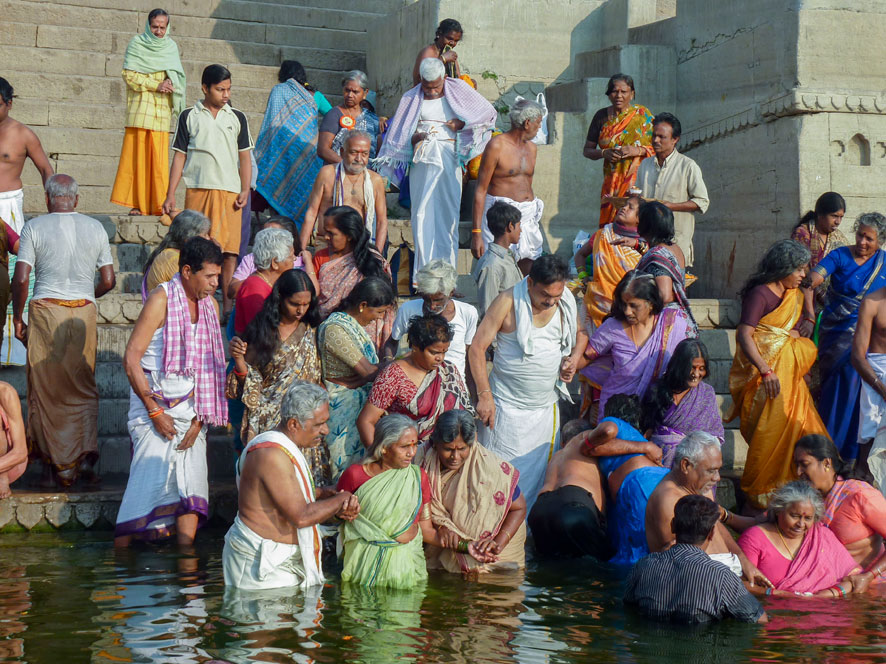
We’ll take a stroll along the Ghats so you can experience everything around us firsthand. The Ghats of Varanasi are truly something to behold; it’s a profound experience. The best times to visit the ghats are always at dawn and dusk, both to avoid the heat and because those are the times when sadhus and pilgrims visit them.

Ghat means ‘step’ and refers to the stairway or steps leading down to the water—a river, a lake, etc. In Hindi, the word ghat always refers to the areas of holy cities along the sacred river. Many of the ghats were built when Varanasi was under Maratha rule.

In Varanasi there are more than 80 ghats , and you can walk all of them. You’ll see people taking the holy baths, washing clothes or dishes and pots, children playing and swimming, and many young people playing cricket, which is our national sport, a legacy from the English.

Among all the ghats of Varanasi, there are some very special ones:

Ashashwamedh Ghat is the main ghat and the site of the aarti ceremony held every evening at dusk. Located near the Vishwanath Temple, it is likely the most visited ghat. Two Hindu myths are associated with Ashashwamedh Ghat. One tells of Brahma creating this ghat to welcome Shiva. The other legend recounts that Brahma sacrificed ten horses here during the Ashwamedha Yajna ritual (an important royal ritual within Vedic religion). Near Dashashwamedth Ghat and overlooking the Ganges is Jantar Mantar, an observatory built by Maharaja Jai ​​Singh of Jaipur in 1737. Every evening, a group of priests performs the aarti, the “Agni Pooja” (Fire Worship), where a special dedication is made to the god Shiva, the Ganges River, the god Surya (Sun), Agni (Fire) and the entire universe.

Pancha Ganga Ghat . Where the waters of five rivers are said to converge: the Ganges, the Yamuna, the Saraswati, the Kirana, and the Dhutpapa. Here, the Gyanvapi Mosque was built by the Mughal ruler Aurangzeb after he destroyed a huge Hindu temple.

Manikarnika Ghat . This ghat is a must-see in Varanasi. Dozens of bodies are cremated here daily, and their ashes are scattered in the sacred Ganges River. It is one of the oldest ghats in Varanasi and is revered within our religion, and we expect respect and silence here. Out of respect for the deceased and their families, taking photos of the cremations is prohibited.

Kedar Ghat is painted and is usually full of people bathing, ideal for taking photos.

Narad Ghat is where it is recommended that you do not bathe with your spouse, as there is a legend of discord.

Scindia Ghat, also known as Shinde Ghat, features a Shiva temple partially submerged in the river. In the alleyways of this area, we will visit some of Varanasi’s most influential shrines; according to tradition, Agni (the Hindu goddess of fire) was born here.

Lalita Ghat was built by the last king of Nepal and is located north of Varanasi. Here we will see the Ganges Keshav, a wooden temple built in the Kathmandu style. Pilgrims visit it to receive blessings and protection from diseases such as leprosy and other skin ailments.

Assi Ghat is a popular spot with many hotels and restaurants. It’s a favorite among painters and photographers. It’s the southernmost ghat in Varanasi and is especially crowded during festivals. It’s said to have a capacity of 22,500 people.

Tulsi Ghat owes its name to the poet and saint Tulsidas, who lived here while writing the Ramcharitmanas. In September, Lolark Sashi is celebrated here, when thousands of women approach the sacred Ganges to bless their children and pray for protection from skin diseases. Also located at Tulsi Ghat is the Sankat Mochan Foundation, a non-governmental organization that has been working to clean the Ganges River since 1982.